Wednesday, May 9, 2007

Patrick Corcoran Named "Zizzle-Zot Reader of the Month"

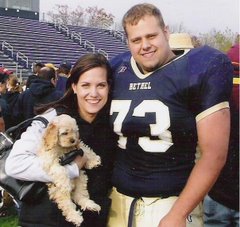
Congratulations to Bethel University graduate, internationally recognized Halo player, and all around kick-ass dude Patrick “P Corcs” Corcoran on being named May’s “Zizzle-Zot Reader of the Month.”

It was a fierce competition, but Pat was finally able to edge out some weird old guy who checks my blog hourly to win the prestigious award when he posted Zizzle-Zot, etc.’s first ever comment following the “Tequila Added to Axis of Evil” article. Pat, one of the blog’s most loyal fans, commented that he “liked the last two posts,” cementing his legacy as Zizzle-Zot, etc.’s first ever “Zizzle-Zot Reader of the Month.”

Past awards for Pat include All-MIAC honors for football during his years at Bethel, a top six finish for the “Coolest People to live in Arden Village East Townhouse D4 During the ’03-’04 School Year,” and winner of “Best at Remembering Lines from The Princess Bride.”

Congratulations, P Corcs, on this much deserved award.

Tuesday, May 8, 2007

Tequila Added to Axis of Evil

President Bush called an emergency press conference Sunday evening to declare his newfound arch-nemesis Tequila the latest addition to the axis of evil. The potent spirit joins Iraq, Iran and North Korea as forces accused of threatening American interests.

After regaining consciousness in the White House rose garden following late night Cinco de Mayo festivities, Bush decided that something had to be done about this “growing threat to American security.” Following a meeting with his joint chiefs, at which Secretary of State Condoleeza Rice accused Tequila of attempting to dull the president’s ability to speak, drive, and make wise decisions, Bush gathered the press and addressed the nation.

As part of the campaign Bush is targeting all Agave plants and has issued a nonbinding resolution prohibiting worms from being placed in bottles. “Worms are insects. Insects and booze don’t belong together. It’s unsanitary, unappetizing, un-American. I ate one on a dare, and I lost my presidential dinner. Wasting food is bad for the economy. And then I passed out in a pool of my own vomit. I could have drowned. That’s a threat to my presidency,” Bush emphasized.

Bush has also sent over 600,000 troops, nearly triple the force used to occupy Iraq, on a mission to destroy the small Mexican town of Tequila, where a majority of the liquor is produced.

To put a face to the evil the administration has condemned the actions of former Van Halen singer turned Cabo Wabo Tequila distiller Sammy Hagar, accusing him of treason and issuing a warrant for his arrest.

Monday, May 7, 2007

The Insidious Adventures of the Insipid Carl Cahalan

Before Carl Cahalan set out to write the Great American Novel it never occurred to him to ask the Great American People whether they wanted their novel to be written. It didn’t bother him that he wasn’t American at all, having only immigrated to the border town of International Falls 3 months prior after he was involuntarily exiled from Fort Frances, Canada (but we’ll get to that later). Carl Cahalan never even stopped to wonder who would read the Great American Novel, as reading had become unfashionable at the turn of the century. I suppose none of these things mattered much. Carl Cahalan, you see, was a terrible writer.

Carl Cahalan’s problem when it came to writing was that he didn’t understand how to use a comma. Granted the comma is a slippery device and is perhaps the most misunderstood concept known to man, but Carl’s use was more odd than necessarily wrong (the result being that one could not put one’s finger on one’s aversion to Carl’s writing). Carl would use the comma, irregularly, to separate words that, did not need to be separated. He accredited this erratic behavior to his unique style and claimed it was a deliberate effort. But the affect it had on readers could best be described as panic as they were not given sufficient time to in or exhale completely between punctuations. Inevitably their heart rates would quicken, beads of sweat would shimmy down their brows, they would hyperventilate, pass out, and without proper medical attention die. Not a pleasant scene, particularly for a mild-mannered reader looking to enjoy a sunny afternoon.

The truly odd thing about Carl’s writing was that while he could not for the life of him grasp the comma, he used the semicolon effortlessly and flawlessly. It was a sign of Carl’s great genius that he could so elegantly plop this intimidating piece of punctuation between closely related independent clauses not joined by a coordinating conjunction. But Carl Cahalan hated the semicolon, which he regarded as pretentious and stuffy, and used it so sparsely that few ever saw his astounding ability firsthand (fortuitously, his sparing use of the mark was precisely the behavior that made his usage correct).

Carl’s strange use of punctuation, however, was not the thing that made Carl’s writing terrible. These are merely symptoms of a terrible writer. Carl’s primary problem when it came to writing was that he didn’t know where to start a story, and had even less sense where to end it. His tales were full of “such and such happened, but to understand that I need to take you back to such and such a time and such and such a place, but first I must tell you this much about such and such, which is to say...” It was really quite ingratiating to readers disposed towards linear stories, as American readers are.

Needless to say, Carl’s blend of eccentricities made him unpopular in the small town of International Falls, where the townspeople prided themselves on down to earthiness and a remarkable resiliency to the cold. They didn’t believe for a second that Carl could, as he claimed, write the Great American novel. This cynicism grew partly out of the fact that Carl was not American, but mostly out of the fact that Carl Cahalan (as everyone knew) was a terrible writer.


To be continued…

Friday, May 4, 2007

A (Not so (Very)) Brief History of the Middle East Part 17: The Finale Part 2: So What Happened? (I Promise, This Really is the End)

Yesterday I expressed my support of the war…in theory. The actual handling of the war is another story. It has turned into a messy affair, been bungled at every step of the way and now exists as quite another beast.

Believe me when I tell you that I take what the media says with a grain of salt. The bottom line is that they have no real sense of the situation on the ground in Iraq. They can’t possibly know what is going on as they are too far removed. Sure they have embedded correspondents, but these reporters are privileged to security measures beyond the average soldier (and obviously far beyond the average citizen). The same can be said of politicians living 6,000 miles from the combat zone. Neither Bush and his staff nor the Democrat majority can have any real tangible sense of what is going on as they are just as removed as the media.

So who do we turn to for accurate war assessments? Clearly the commanders that are physically in Iraq leading the ground effort. And what are these men saying? Current Commander Gen. David Petraeus has said “military action is necessary to help improve security…but it is not sufficient.” He is referring to the need for diplomacy, but Bush, until recently, has stubbornly refused to deal with two of the most important players, Iran and Syria. Lt. Gen. John R. Vines, who led the coalition forces from 2005 to 2006, has stated that the Iraqi insurgency has the support of millions of Sunnis who reject a US installed government. This contradicts assessments made by Donald Rumsfeld and Dick Cheney (who believed the insurgency consisted solely of Saddam loyalists and foreign Jihadists). Now retired Gen. Barry McCaffrey told the Pentagon in a private report that the “war is lost,” and that the US military would be unable to stop the growing violence claiming 1,000 Iraqi civilians a month.

Taking into account the tight-lipped nature of the military, this level of disclosure paints an ominous picture, particularly after Rumsfeld’s efforts to keep top military officials quiet. Consider the example of Army Chief of Staff Gen. Eric K. Shinseki, who admitted that he felt hundreds of thousands of troops would be need to secure Iraq. Rumsfeld’s offices called this estimate “wildly off the mark” before leaking word of Shinseki’s replacement 15 months before he was set to retire, both embarrassing and neutralizing him.

So what went wrong? In my (un-authoritative) assessment it boils down to two things. First, the US government and intelligence community did not, and have yet to, grasp the reality of the situation they walked into. Second, it has been suggested that the region was on the brink of crumbling anyway.

First things first. The architects of the war, bottom line, were working with incomplete blueprints. They failed to grasp the depth or nature of pre-existing conflicts, the character of the Iraqi people, and the vein of anti-Americanism that permeates the region. The Pentagon didn’t have a plan in place to secure and rebuild a country shattered by a war following years of oppression. American military commanders initially wanted 100,000 additional troops to aide in this effort. These troops were never provided. Central Command proposed a force of 380,000 to attack and occupy Iraq. Rumsfeld decided on 40,000. They finally compromised at 250,000, but most of these troops were either delayed or never sent as a result of Rumsfeld’s micromanagement.

The theory was that the war would be over and most of the troops could be brought home once Saddam was ousted. The CIA predicted that the Iraqi Army would turn against Saddam and that pro-American Iraqis would pick up the pieces. This never happened. We went in thinking that we would be welcomed by all of Iraq as liberators. True, some saw US troops that way, but it seems like the majority saw it as an unwanted foreign occupation and went to work defending their country. Others saw it as an opportunity to reignite age old sectarian conflicts and win influence for their respective sects. Others greedily saw it as an opportunity to take advantage of a power vacuum. And those who remain live with the consequences.

In addition to being ill-prepared when we invaded Iraq, we failed to recognize the delicate balance which the stability of Iraq was resting on before we became involved, which brings us to the second reason we find ourselves in a disaster area.

Ali Allawi, a man who knows what he is talking about (he has served as Minister of Defense and Minister of Finance since Saddam’s capture), recently published a memoir titled “The Occupation of Iraq: Winning the War, Losing the Peace.” While Allawi certainly questions the execution of the war, he asserts that Iraq was on the brink of implosion well before American troops arrived.

When the Coalition arrived in Baghdad on 9 April, 2003, it found a fractured and brutalized society, presided over by a fearful, heavily armed minority. The post-9/11 jihadi culture that was subsequently to plague Iraq was just beginning to take root. The institutions of the state were moribund; the state exhausted. The ideology that had held Ba'athist rule together had decayed beyond repair.

The problem stemmed from the precarious balance between the majority Shiites and the Saddam controlled Sunni dictatorship. By controlling the media, educational system and economy Saddam was able to eradicate any sense of Shiite identity. When the mass killings started following the Gulf War, all hope was lost for many Shiites.

In the years between the Gulf War and the invasion Iraq was plagued by unemployment, poverty, illiteracy, and the exodus of intellectuals. Saddam responded with theocratic rhetoric, calls for jihad, and “morals” campaigns. America was blamed by many for the plight of the country (perhaps rightfully so). To the Shiites, America was the country that allowed Saddam to stay in power and watched as he slaughtered their people. To Sunnis and Shiites alike, America was the country that imposed harsh sanctions which hurt the average citizen far more than the government.

Simply put, Iraq was a breeding ground for radicalism, hate, fear, and violence, and in large part America was to blame. The chaos in Iraq was inevitable, we just accelerated the process by creating a power vacuum.

This by no means clears America. The lack of planning, leadership and direction in the rebuilding effort is inexcusable, and we have a long ways to go in correcting those mistakes.

The problem is that both Republicans and Democrats need to quit playing politick and pull their heads out of their asses. Republicans need to understand the principle that violence begets violence. It will be impossible to beat Iraq into submission with force. The insurgency is fighting with the conviction that they are defending their faith and their country. That combination of beliefs will simply never back down, never quit, never lose. Diplomacy will be needed to settle disputes and broker agreements, and this may mean working with those we regard as enemies.

Democrats need to understand that a pullout date is not the answer, and to attach one to a war funding bill is political posturing at its worst. If they thought about it logically they would see what a terrible idea it is just like the Republicans. Bush actually had a good argument in his speech after he vetoed the bill when he pointed out that setting a pullout date simply tells violent radicals when America will be gone. All they have to do is gather strength and wait. Democrats also need to understand that leaving now would mean abandoning all of those average citizens, leaving their fates in the hands of brutal militants.

So is a troop surge the answer? I think it depends on the purpose of the troop surge. If we’re thinking we can send more soldiers to beat down the insurgency, in my opinion we’re dead wrong. If the troops go with the intention of aiding the rebuilding effort, training Iraqi troops and making the country safer for its citizens, then I think it might be the right play.


And I’m spent. I’ve given all I have on the war in Iraq, and perhaps more (definitely more than anyone wanted to know). “A (Very) Brief History of the Middle East” has drawn to a close.

It seems almost anticlimactic. Should there be a ceremony, should taps be played, should there be some grand gesture symbolizing the end of an epoch? No. I wash my hands of the whole messy affair and thank you for joining me in this effort to better understand the world around us.

Thanks for reading.

Thursday, May 3, 2007

A (Very) Brief History of the Middle East Part 16: The Finale

“A (Very) Brief History of the Middle East” is drawing to a close. We have explored the region, done our best to understand the varied histories, beliefs, and politics behind the conflicts that have thrown Middle East into chaos, and are, I hope, that much closer to understanding the world around us.

So far I have done my best (I acknowledge there have been some slips) to provide an unbiased, objective assessment of the facts and situations currently embroiling the region, and it has been a struggle. I am but a humble blogger, dear readers, but as anyone who knows me can attest to, I’m an opinionated blogger. And now you will hear what I have to say, like it or not.

I am blogger, hear me roar.

4 Years, 3,000 Lives, $500 Billion: Was It Worth It?

I don’t support war on principle. I’ll admit that I’m a peace lover and wish that lives never needed to be lost. President Bush has faced harsh criticism since the outset of the invasion of Iraq that it was an unnecessary evil, that he has sacrificed lives and resources for ill-conceived war mongering.

Despite my anti-war stance, I do believe that there are at times necessary evils, and in certain instances war is necessary. I don’t believe that this was one of those instances. I don’t believe that the invasion of Iraq was necessary.

Saddam Hussein didn’t pose an imminent threat (any more so than in the rest of his 30 year reign of terror). His “cache of weapons of mass destruction” was never found and seemingly amounted to little more than poor intelligence (damn you and your “slam dunk” George Tenet). Attempts to tie Iraq to Al-Qaeda were weak at best, and Saddam had not committed any (more excessively) egregious human rights violations since the last time a Bush could have captured him during the first Gulf War.

That being said, I will now assert my unpopular opinion and say that I supported the invasion then, and I support the war now. Do I contradict myself? Good. I contain multitudes (Walt Whitman allusion. Read a book).

Let me attempt to clarify. No, I don’t believe the war was imminently necessary. If the US had not invaded Iraq, Saddam would still be ruling the country with his brand of tyrannical politics, the country would probably still be at the boiling point of sectarian violence (if it had not yet spilled over on its own), and the Iraqi picture would look much like it looked in the ten years following the Gulf War: Poverty stricken, oppressed, fear and hate-filled.

But do any of those things, directly, have anything to do with America? No, aside from oil (and realistically Iraq doesn’t supply us with that much of our oil anyway) we could very easily not give a damn about the problems in Iraq. America could have remained uninvolved, and remained safe…for a while.

The question is: how long do we imagine peace bought by isolationalism would have lasted? So many war protestors are screaming for us to stay out of world affairs, but as the world’s superpower the United States can’t afford to turn inward and ignore the plight of countries in which we have a vested interest. How quickly we forget Pearl Harbor, where the exact same isolationalist thinking made us a target of Japan.

Putting American interests aside, I do believe that while the Iraqi war has not gone according to plan, it has done some good for the international community. Let’s look at what was accomplished:

A despotic regime that had for years terrorized its citizens, killed hundreds of thousands, destroyed its nations economy, and been a consistent thorn in the side of the rest of the world was deposed. I really don’t care what your views on international politics are. I’m an ardent independent and I pride myself on seeing the bullshit on both sides of the line. Conservatives, you’re full of it for manipulating intelligence, for exaggerating or concocting Al-Qaeda ties and weapons caches to whip the nation into war frenzy. You lied to the American public, and I wouldn’t expect forgiveness. And let’s not forget your refusal to acknowledge that this war has gone to hell.

But don’t get too comfortable on that high-horse, liberal protestors. Your platform exalts justice for all, on caring for the poor and sick and suffering. Where was this compassion when it came to the citizens of Iraq, suffering and dying just like the men and women of Darfur? If we were to intervene in this genocide burdened region of Sudan,
would you support or protest? It’s a lose-lose for you. Either way you’re a hypocrite. If you support intervention, then there is no reason you shouldn’t support intervention in Iraq. If you protest, you stand directly against one of your core beliefs, the belief that America must help those who can’t help themselves. That’s a tough spot to be in.

I believe America has a responsibility to act on behalf of those who can’t protect themselves. It was inaction that led to 6 million Jews dying in the Holocaust, millions of Cambodians dying under the Khmer Rouge regime, and millions more dying in genocides plaguing African and Latin American nations. As the Reverend Martin Luther King Jr. said “He who passively accepts evil is as much involved in it as he who helps to perpetrate it. He who accepts evil without protesting against it is really cooperating with it.”

Saddam Hussein was exactly the breed of genocidal maniac that needs to be removed from power. Does anyone really believe that sanctions and diplomacy would have accomplished this end? He had already defied the UN, expelled weapons inspectors from the country, and violated the resolutions created following the first Gulf War. Saddam simply did not care about UN intervention because he knew the UN was weak. They are reluctant to agree to the use of force, and sanctions only hurt the people of Iraq, not Saddam himself.

So, while I do not think the invasion of Iraq was imminently necessary, I do believe it was justified (look forward to a future post about this absurd belief in “justifiability” concerning warfare).


There it is. As an idea, I support the invasion of Iraq. Surprised? Disgusted? Aghast? That’s fine. Tomorrow I’ll contradict myself with a counterpoint. Inner conflict…exciting.

Thanks for reading,

Wednesday, May 2, 2007

A (Very) Brief History of the Middle East Part 15: What's in a Name?

Explainer: How do Muslims get their names?

This is not necessarily relevant to the conversation at hand, but it piqued my curiosity and I couldn’t leave it alone. There seems to be a pattern to the way Muslims are named, but what is it? I set out to discover the method. Here’s what I found:

The main part of a persons name is known as the “ism” (like Christian first names). They are typically either Arabic words with a significant meaning (ex: Amal=hope, Mahmud=praiseworthy) or a combination of “abd” (which means servant) and another word, usually one of the Muslim names for God (ex: Abdullah=servant to the God). One common mistake made with this part of the name is that “Abdul” is not in itself an “ism.” “Abdul” is a variation of “abd” and alone means only “servant of.” Also, any word following “Abdul” is a part of that man’s personal name, and the two need to be said in conjunction.

At times, a “kunya” precedes or replaces the “ism.” A “kunya” refers to the persons first born son (ex: Abu Karim=father of Karim).

The “nasab” indicates the patriarchal heritage using either “ibn” (no idea how to pronounce this) or “bin.” Both of these mean “son of.” So Osama bin Laden is “Osama, son of Laden.”

The “nisba” most closely resembles the Christian last name and indicates a person’s occupation, geographic home, or descent. This name will travel with families through many generations.


Interesting stuff…at least I thought so. Come back tomorrow. It is the beginning of the end.

Thanks for reading.

Tuesday, May 1, 2007

A (Very) Brief History of the Middle East Part 14: The Much Anticipated Who's Who

I may be overly optimistic here. I can’t say for certain that this post has been “anticipated.” I’ve certainly built up the suspense (I’ve been talking about it since the beginning of the series). I assure you that the hype was completely unintentional, being the result of the unexpected length of this series, and chances are the Who’s Who will fall pathetically short of any expectations set for it.

In reality chances are so few people have been reading this blog or will read this blog, that it doesn’t make one bit of difference, so I’ll quit with the preface and get on with it.

The point of this post is to outline which of the Middle East’s major players are Sunni and which are Shiite. Hopefully when I’m finished we can get a better grasp on some of the sectarian conflicts taking place in the region.

Sunni: The Sunnis often consider themselves the more traditional sect. They consider Shiites to be heretics because they do not follow the originally chosen Caliphs. Worldwide, 90% of the world’s Muslims are Sunni.

Amongst the most prominent Sunni Muslims are Osama bin Laden (Making Al-Qaeda ostensibly a Sunni organization, though they are usually able to set aside sectarian differences for their common hatred of the west). Saddam Hussein and his Ba’ath party were also Sunni and were oppressive and often brutal to Shiites (one of the main causes of the sectarian conflicts that are going on now). This stems from the Iraq-Iran war, in which predominantly Shiite Iran tried to install its brand of Islamic rule in the rest of the Middle East.

Saudi Arabia is predominantly Sunni, as well as Syria (though they are ruled by a small Shiite subsect) and Kuwait.

Shiite: The Shiites consider the Sunnis to be heretics because their religious leaders are outside of the Mohammedan bloodline. As a whole, they have long been oppressed by the larger Sunni sect.

The most influential Shiite nation in the Middle East is Iran. They are suspected of funding most of the Shiite Militias in the region, including the Lebanese Hezbollah militia, the Palestinian Hamas militia, and Iraq’s Mhadi Army (the militia of Shiite cleric Muqtada al-Sadr.)

In the first election in Iraq since Saddam Hussein was removed from power the Shiite’s (backed by al-Sadr) swept and now control the Iraqi political scene (Iraq is 60% Sunni, 40% Shiite, but Sunnis boycotted the election). Iraq’s Prime Minister Nuri al-Maliki, as well as most of the country’s military and police force, are Shiite. This has further fed sectarian distrust as Iraqi Sunnis accuse the police of acting as death squads.


If you want to know more about why so much sectarian conflict exists, check out this article from Time Magazine: http://www.time.com/time/magazine/article/0,9171,1592849-1,00.html
It’s very insightful, and definitely worth a look. I’ll be back tomorrow with an interesting explainer, and then wrap this series up.

Thanks for reading.